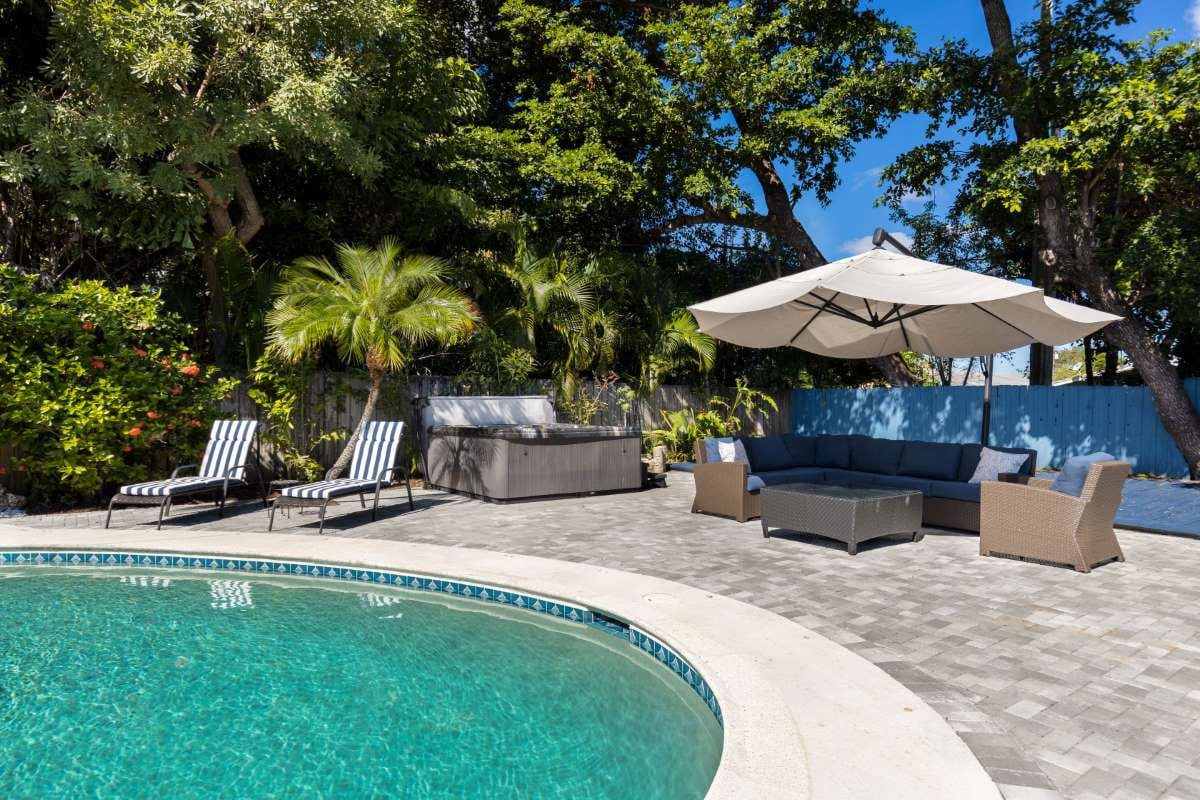
📌 Key Takeaway: Pool service technicians in Boynton Beach who price their accounts based on pool type — not just count — consistently earn higher margins and retain customers longer.
Why Pool Type Changes Everything for Your Pricing Model
If you are quoting every pool in Boynton Beach at the same flat rate, you are leaving money on the table — and probably burning out your technicians. A basic vinyl-liner above-ground pool and a large freeform concrete pool with a spa and water feature are not the same job, and your pricing should reflect that reality.
Boynton Beach has a dense mix of residential pool types. Older neighborhoods near the Intracoastal tend to have concrete pools built in the 1980s and 1990s, many with attached spas. Newer developments west of I-95 are loaded with fiberglass pools that were installed as part of new construction packages. Above-ground pools appear throughout the city in rental properties and more modest residential lots. Each of these pools carries different labor requirements, chemical consumption patterns, and equipment service needs that directly affect your cost of doing business.
Understanding those differences is the foundation of a pricing strategy that actually works at scale — especially if you are building a route business and looking at pool routes for sale to grow your customer base quickly.
Concrete Pools: Higher Maintenance, Higher Revenue Potential
Concrete pools are the most maintenance-intensive type you will service. The porous surface of plaster and gunite consumes significantly more algaecide and chlorine than smooth fiberglass or vinyl surfaces. Brushing is a weekly requirement, not an optional task, and acid washing every three to five years adds to the lifecycle cost for the pool owner.
For a service professional, this translates directly into higher per-visit time. Budget at least 45 to 60 minutes for a standard concrete pool with a spa, compared to 25 to 35 minutes for a comparable fiberglass pool. If your route pricing does not account for this time difference, your effective hourly rate drops significantly as you take on more concrete accounts.
In Boynton Beach, where Florida's year-round heat and heavy rain accelerate algae growth and pH drift, concrete pools in particular require tighter chemical management. Many technicians charge a premium of $15 to $30 per month over their base rate for concrete pools with spas. That premium is justified and most clients accept it once it is explained clearly.
Fiberglass Pools: Efficient to Service, Competitive to Price
Fiberglass pools are often the easiest pool type to service efficiently. The non-porous gel-coat surface inhibits algae growth, chemical demand is lower, and brushing is rarely needed. A well-maintained fiberglass pool can often be serviced in 20 to 30 minutes once a routine is established.
The efficiency advantage means fiberglass-heavy routes produce better revenue per hour of labor. If you are evaluating pool routes for sale in the Boynton Beach market, a route with a high concentration of fiberglass pools in newer subdivisions west of town is often worth a premium because of the labor efficiency built into those accounts.
That said, fiberglass pools are not maintenance-free. Bead blasting, surface oxidation, and equipment issues still occur. Pricing these accounts too low in a race to fill a route is a common mistake — even efficient pools require professional attention, and your pricing should reflect the value you provide, not just the minutes you spend on-site.
Above-Ground Pools: Volume Accounts That Require Separate Pricing Logic
Above-ground pools in Boynton Beach are typically smaller, simpler, and quicker to service. They represent a real opportunity for newer operators building density on a route, but they require their own pricing category.
Chemical costs are lower due to smaller water volumes — most above-ground pools hold 5,000 to 15,000 gallons versus 15,000 to 30,000 gallons for in-ground options. Filter systems are smaller and require less time to clean. Equipment failures tend to be less costly to repair. All of this means your service cost is lower, but so is the ceiling on what the market will pay.
A practical approach is to set a minimum monthly service rate that covers your true cost of each stop — fuel, chemicals, labor, and overhead — and apply it uniformly to above-ground accounts regardless of how quick the visit feels. Many operators in South Florida set this floor at $80 to $100 per month for basic above-ground maintenance. Going below that floor makes it difficult to build a profitable route.
Building a Tiered Pricing Structure for Your Boynton Beach Route
The most effective approach for pool service operators in Boynton Beach is a tiered pricing structure that starts with pool type and layers on additional variables from there. Here is a framework that works in practice:
Base rate by pool type: Fiberglass pools start at your standard rate. Concrete pools carry a $15 to $25 monthly surcharge. Above-ground pools are priced at or just above your minimum threshold.
Size and feature adjustments: Any pool over 20,000 gallons, any pool with an attached spa, and any pool with a water feature or automation system should carry an additional monthly charge. These features add measurable time and chemical cost to every visit.
Frequency and scope: Standard weekly service is your default. Some clients want bi-weekly visits — price those at 60 to 70 percent of the weekly rate per visit, not 50 percent, because your fixed costs per stop do not scale linearly.
Chemical inclusivity: Decide whether your quoted rate includes chemicals or bills them separately. For concrete pools with unpredictable chemical demand, separate billing protects your margin. For fiberglass pools with stable consumption, all-inclusive pricing is easier to sell and easier to manage.
Communicating Pricing Differences to Clients
Clients in Boynton Beach are accustomed to shopping around for pool service, and they will notice if your quote is higher than a competitor's. The key is leading with the explanation before they push back.
When you quote a concrete pool at a higher rate than a fiberglass pool, say so directly: concrete surfaces require more chemicals, more brushing time, and more careful monitoring to prevent algae and scale buildup. Most clients understand and appreciate the transparency. The ones who do not are often the clients who will argue about every invoice down the road.
Clear pricing communication also reduces churn, which is one of the biggest threats to a growing route business. When clients understand what they are paying for and why, they are far less likely to switch to a cheaper operator who under-promises and over-bills.
What This Means If You Are Buying or Selling a Route
If you are assessing the value of a pool service route in Boynton Beach, pool type distribution matters as much as account count. A 150-account route made up primarily of fiberglass pools will run leaner and produce more consistent margins than a 150-account route with a high concentration of older concrete pools in mixed condition.
Ask for a breakdown of pool types before you agree to any route purchase price. Factor in your per-pool service time for each type, your expected chemical costs, and the realistic attrition rate for that neighborhood and price point. That analysis will tell you whether the multiple being asked is fair — and give you a roadmap for pricing those accounts correctly from day one.