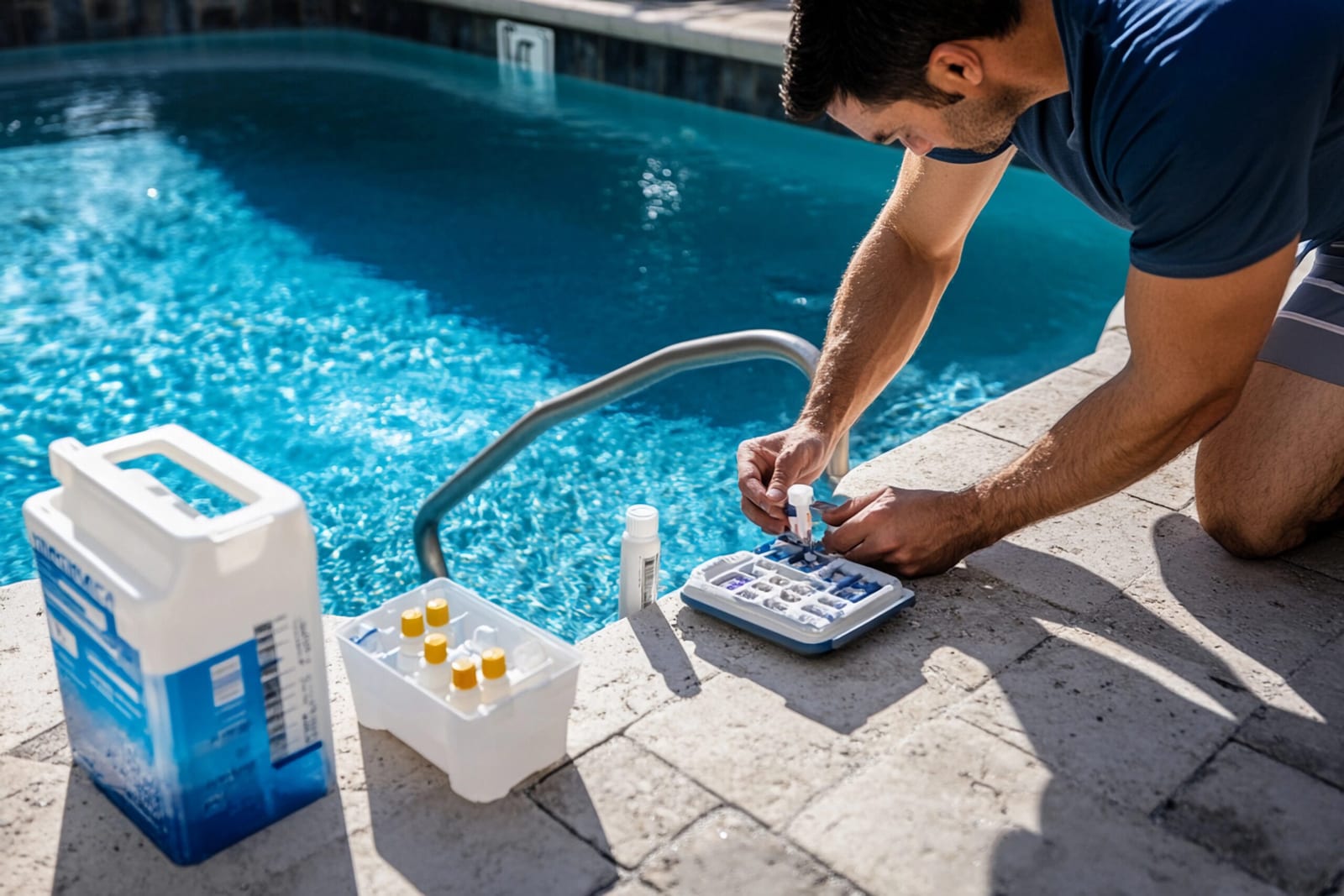
📌 Key Takeaway: A solo pool service operator can scale revenue past six figures by tightening route density, automating billing, and acquiring established accounts instead of payroll.
Tighten Route Density Before You Touch Anything Else
The single biggest lever for a one-person operation is windshield time. If you are driving 45 minutes between three accounts, you are paying yourself nothing for that hour. Pull your customer list into a spreadsheet, plot every stop on Google My Maps, and color-code them by service day. The goal is to finish each route inside a 10 to 12 mile radius with at least 15 pools per day at roughly 25 minutes per pool. That is 75 stops per week handled by one person, which at an average billing rate of $140 per month per pool puts you at $10,500 in recurring monthly revenue without a single helper.
When a new lead comes in outside your tight zone, do not chase it. Either raise the price to compensate for travel or refer it to a competitor in exchange for a reciprocal handoff. Density beats volume every time you work alone.
Automate the Office Work You Hate
Most solo techs lose Sunday nights to billing, texting customers, and chasing late payments. Skimmer, Pool Brain, or HCP can run your route sheets, send before-and-after photos, log chemical readings, and auto-charge stored cards on the first of the month. Expect to spend $50 to $90 per month on software, which is cheaper than one hour of your time per week.
Set up two automations the day you sign up: a recurring monthly invoice with auto-pay enabled, and a service-complete text that fires the moment you mark a pool clean. Those two flips alone cut customer service calls by roughly half because clients stop wondering whether you showed up.
Charge Like You Are Not Replaceable
Solo operators undercharge because they benchmark against companies that need to fund payroll. You do not. Audit every account quarterly. Any pool that takes more than 30 minutes, sits more than 8 miles from your nearest stop, or has an owner who texts more than twice a month should either get a price bump or get cut. Send a short message: "Effective next billing cycle, your monthly service is moving from $135 to $155 to reflect current chemical and travel costs." Expect roughly 5 to 10 percent to cancel. That is fine; you just freed capacity for higher-margin work.
Buy a Route Instead of Hiring
The instinct when demand outstrips your schedule is to hire a tech. Resist it. A W-2 employee in Florida or Texas costs roughly $4,500 to $5,500 per month fully loaded, plus a truck, insurance bump, and the management overhead of training and quality control. For similar capital outlay, you can buy an established book of business.
Superior Pool Routes sells warranted accounts at roughly 10 to 12 times the monthly billing, with a replacement guarantee on any customer that cancels in the first 60 to 90 days. Browse current inventory of pool routes for sale to see what is available in your service area. The math is straightforward: a $40,000 purchase that produces $4,000 in monthly recurring revenue pays itself back inside a year, versus an employee who is a permanent expense.
Subcontract the Peaks, Not the Baseline
There will be weeks when a heat wave triggers a wave of algae calls or your back goes out for three days. Build a bench of two or three independent contractors you can call for overflow. Pay them a flat fee per pool, around $30 to $40, and let them keep their own routes. You stay a single-operator business on paper, your customers stay covered, and you avoid the payroll tax, workers' comp, and HR exposure that comes with employees. Just make sure you have a written 1099 agreement and that they carry their own liability coverage.
Sell Repairs Without Becoming a Repair Company
Every solo route operator should be quoting filter cleans, salt cell replacements, pump motor swaps, and acid washes. These are 30-minute jobs that bill $150 to $600 with parts you can pick up at any Pinch A Penny or SCP Distributors. You do not need a CPC license to do most cleaning and replacement work, just a good relationship with a licensed contractor for anything requiring a permit. Aim for repair revenue equal to 20 to 30 percent of your monthly service billing. On a $10,000 per month route, that is an extra $2,000 to $3,000 with no new customers.
Geographic Expansion Without Headcount
Once your local route is full and tight, the next move is acquiring a second cluster 20 to 40 minutes away that you can service one or two days per week. Run Tuesday and Wednesday in Cluster A, Thursday and Friday in Cluster B. This is where established route inventory matters most: trying to build a remote cluster from scratch with door hangers will take 18 months. Buying it takes a week. Superior Pool Routes lists clusters by zip code, so you can target a specific suburb and see what is available before you commit. Their inventory page for pool routes for sale updates as new accounts come in.
Track Three Numbers Every Sunday
Effective hourly rate (weekly revenue divided by hours worked including drive time), monthly cancellation count, and repair revenue as a percentage of service revenue. If your effective hourly drops below $75, you have a density or pricing problem. If cancellations exceed 2 percent per month, you have a service quality problem. If repair revenue stays under 15 percent, you are leaving the easiest money on the table. Review these three numbers every weekend and adjust before small leaks become big ones.
Growing without staff is not about doing more; it is about cutting drag, charging properly, and buying recurring revenue instead of renting labor.